
Tunable rejection
Adjustable response helps keep the filter centered on the right portion of the band as the system frequency plan changes.
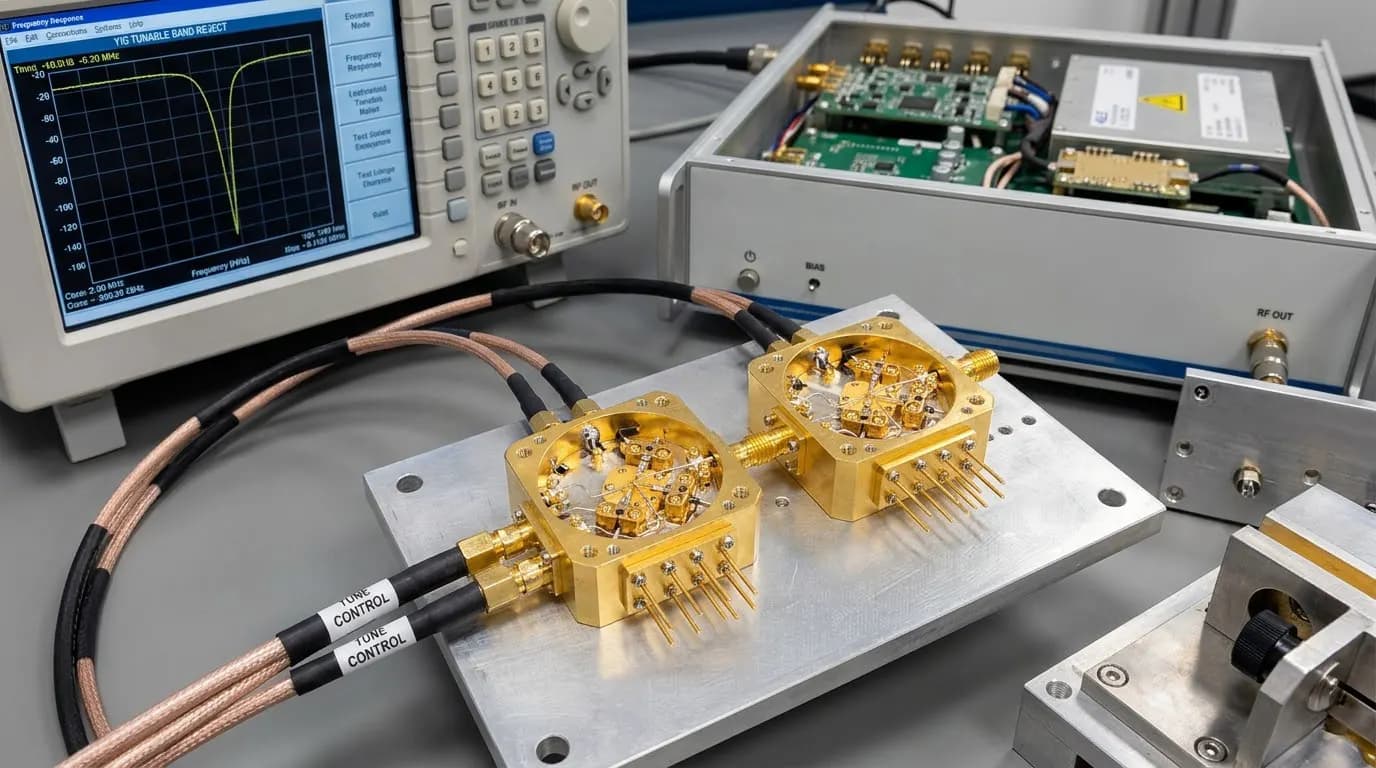
YIG TUNED FILTERS
Microsource YIG tuned filters are intended for interference suppression, receiver protection, and narrowband signal conditioning where selectivity and tuning control matter more than broadband pass-through.
Use them when you need controlled rejection in a dense spectrum environment and want the filter to stay aligned with the operating band.
Product overview
Shapes the RF environment around a band of interest by rejecting unwanted energy before it degrades receiver behavior or downstream analysis.
Usually inside receive, monitoring, or conditioned subsystem paths where fixed filtering is not flexible enough for the operating plan.
Signal conditioning
Tunable rejection filters help protect sensitive stages by suppressing interference, shaping the response around the band of interest, and supporting cleaner system-level operation.
Selective rejection where adjacent-channel or in-band interference needs to be controlled
Tuning flexibility that helps align the filter with the operating frequency plan
Integration-friendly packaging for receiver chains and signal conditioning paths
A practical fit when a fixed filter is not flexible enough for the mission environment
Final tuning range, rejection depth, and packaging depend on the program requirement and the selected configuration.
Capabilities
The design emphasis is controllable spectral rejection and predictable integration into systems that need cleaner receiver or intermediate-frequency paths.
Adjustable response helps keep the filter centered on the right portion of the band as the system frequency plan changes.
Useful when unwanted carriers or adjacent energy must be reduced before it reaches downstream receiver stages.
Supports front-end protection and helps preserve performance when dense spectral environments create overload risk.
Can be packaged for subsystem use with RF interfaces, mechanical constraints, and environmental needs defined by the program.
Specific tuning spans and rejection characteristics should be verified against the approved configuration for each program.
Applications
Tuned filters are most useful when the RF path needs to preserve selectivity and control the spectral environment around sensitive circuitry.
Helps reject interfering energy before or after conversion in receive paths that need cleaner spectral separation.
Supports spectral management in wide or contested environments where unwanted signals can degrade analysis or detection.
Useful as a controllable rejection element when evaluating spectrum hygiene or subsystem behavior under interference.
Works as part of a broader conditioning path alongside sources, converters, amplifiers, and integrated assemblies.
Representative evaluation points
This tuned-filter family page focuses on the parameters that most strongly affect fit and value, rather than presenting one measured hardware example.
| Parameter | Representative value |
|---|---|
| Filter role | |
| Typical function | Interference suppression and receiver protection |
| Most common context | Receiver, SIGINT, EW, and test signal-conditioning paths |
| What to define | |
| Tuning span | The band over which the rejection behavior must stay useful |
| Rejection target | Depth and width of suppression around the unwanted energy |
| Insertion-loss budget | How much conditioning the rest of the receive path can tolerate |
| Program fit | |
| Control approach | Must align with the operating frequency plan and user interface expectations |
| Mechanical integration | Driven by adjacent RF stages, mounting, and screening needs |
Tuning span, rejection depth, insertion loss, and control method should be tied to the approved configuration for the actual receiver or signal-conditioning chain.
Hardware
Tuned filters are typically judged by how cleanly they fit into the receive or conditioning path, so connector access, mounting, and adjacent-stage layout matter as much as the rejection concept itself.
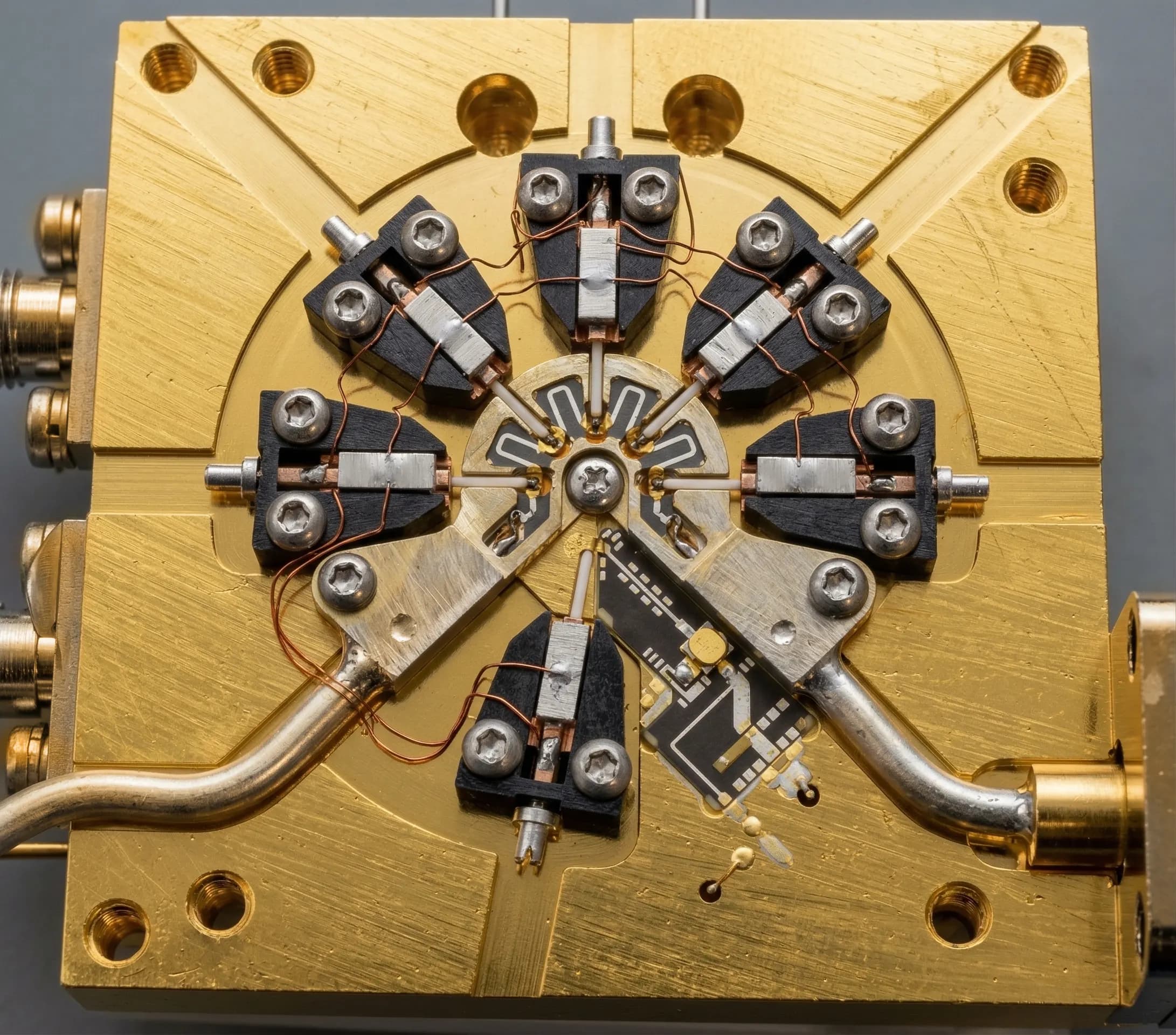
System integration
Tuned filters usually protect or clean up a path that already contains a source, a receiver interface, or a conversion stage. Their value comes from improving the chain, not from existing as a stand-alone artifact.
Representative tuned-filter context
Packaging
Packaging is typically driven by RF interface, mechanical envelope, and environmental requirements rather than a single fixed form factor.
If the filter is part of a larger subsystem, pairing it with the rest of the signal chain early is the safest way to avoid interface surprises.
Related solutions
Tuned filters are most effective when they are chosen alongside the source, translation, and packaging strategy for the full subsystem.
YIG Oscillators
Low-noise tunable source options that often sit upstream of the filter path.
Linear Frequency Converters
Linear up- and down-conversion stages that often benefit from tighter spectral control.
Custom Integrated Microwave Assemblies
Custom subsystem packaging that combines the filter with the rest of the signal chain.
Next step
Talk with Microsource about your interference environment, required rejection behavior, and how the filter needs to fit into the surrounding RF chain.